FEA Consulting
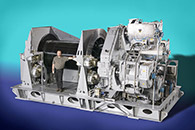
Predictive Engineering brings to bear over 15+ years of FEA consulting in solving your most difficult mechanical engineering analysis challenges. We have direct and validated experience in detailed stress analysis, linear dynamics (normal modes, sin sweep, PSD or seismic analysis), ASME Section VIII, Div. 2 pressure vessel analysis from heat exchangers to NQA-1 nuclear and likewise, from construction to transportation, nonlinear contact analysis for complicated assemblies and plastic thread design, high-power transmissions and gear assemblies, off-shore oil patch winches, top drives, etc. and many other fields. We have also been active in the renewable energy field with complete mechanical stress and dynamic analysis of wind turbine systems, solar panels and photovoltaic systems.
Our work portfolio ranges from deep-diving submarines to large motor home chassis analysis to USAF satellites. The only commonality in our FEA consulting work is that every project has passed our clients’ requirements with flying colors.
CASE STUDIES
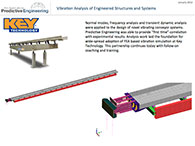 Numerical vibration analysis is one of the core skill sets at Predictive Engineering. Our work has been tested, shaker-tabled and in-the-field benchmarked with tightly correlated outcomes on every model. An industry axiom for vibration work is that a numerical model is normally no better than within 20% of reality. Over the years, our models have consistently been within 10% of experimental measurements and our mode is typically 5%.
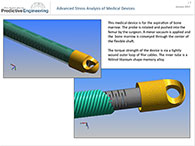 Predictive Engineering has been involved with the analysis of medical devices since 1995 with its first work on an endoscopic surgical stapler to current work on a bone marrow aspiration tool. In all cases, these projects were benchmarked against experimental results and shown to be in tight correlation.
Advanced Stress Analysis of Medical Devices Project Listing Report
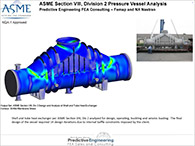 Predictive Engineering has over eleven years of experience in the application of ASME Section VIII, Div. 2. In the nuclear field, Predictive has produced NQA-1 seismic, buckling and fatigue analysis reports on some of the most complicated vessels installed at the Hanford Tank Waste Treatment and Immobilization Plant. Working collaboratively with DOE's contractor, Predictive has pioneered many of the seismic and buckling analysis procedures based on interpretation of ASCE 4-98 and ASME Section VIII, Div. 2 Codes for pressure vessels (PV) containing large internal PV components.
 SpaceWorks provides unique and advanced satellite solutions and have a revolutionary satellite featuring a modular design. One of the company's current projects involves the development of the next-generation of satellite structures for the U.S. Air Force Research Laboratory (AFRL). The system features a modular framework of panels that use a shared electrical and communication bus that can be quickly assembled into a fully functional and ready to launch satellite in a matter of days.
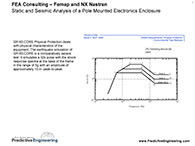
Static and Seismic Analysis of a Pole Mounted Electronics Enclosure
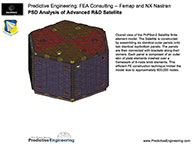 SpaceWorks provides unique and advanced satellite solutions and have a revolutionary satellite featuring a modular design. One of the company's current projects involves the development of the next-generation of satellite structures for the U.S. Air Force Research Laboratory (AFRL). The system features a modular framework of panels that use a shared electrical and communication bus that can be quickly assembled into a fully functional and ready to launch satellite in a matter of days.
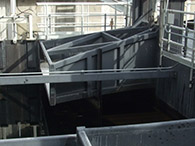 For the operators of the large hydroelectric dams on the Columbia River, enhancement of salmon runs is a key priority. This project replaced existing steel fish passageways with high-strength composite structure that would allow the use of sophisticated fish tracking magnetic field sensors.
Analysis and Optimization of Fiber Reinforced Composite Structures
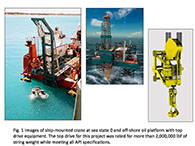 Offshore engineering has grown rapidly in the last few years as the world searches for new resources. Exploring the deep blue requires specialized hardware that can withstand harsh sea conditions (e.g., sea state 5 for ship mounted cranes) and strict safety margins as outlined by Det Norske Veritas (DNV), headquarted in Oslo, Norway (e.g., offshore oil drilling equipment) or by the ship classification society, American Bureau of Shipping (ABS) (e.g., manned submersibles). Two recent projects are discussed that cover the analyses of a ship-mounted crane for the launch and retrieval of a remotely piloted deep sea drill and that for top drive drill assembly used in the north sea oil patch. Both projects provided analysis challenges in understanding the special requirements for rough seas and those imposed by DNV and the American Petroleum Institute (API) for oil field equipment.
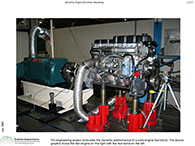 When new car or truck engines are manufactured, a cold spin-up test is often performed. During this test, the engine is spun while vibration transducers, accelerometers and pressure gauges measure the engine’s performance. Ideally, the drive motor that is doing the spinning only transmits pure, clean torque energy to the test motor. Development of a high-stiffness yet well damped drivetrain between the drive motor and the test engine has been and still is a development challenge for many companies.
Cold-Spinning of Engines via the Perfect Drivetrain: Static and Eigenvalue Analysis
 Being a long time enthusiast for all things with two wheels, it was a blast to have an opportunity to work with Norton Motorcycles on the development of their next-generation bike. Their challenge was to validate the structural behavior of their new aluminum engine block which was designed from the ground up to have the classic Norton look along with state-of-the-art weight and performance characteristics. The analysis model was fairly complex with extensive use of my full grab bag of modeling tricks and tweaks.
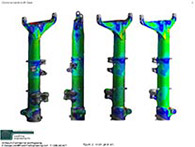 It is not often that a mechanician has the opportunity to execute a complete series of structural analyses on a large structural component that is integral to an aircraft's ability to function. This opportunity presented itself recently during work collaboratively performed with a global aircraft equipment manufacturer in the analysis of new gear sets for a large commercial airplane. As part of their engineering team, my task was to build efficient finite element analysis models of preliminary designs exported from Catia V4 and V5. The complexity of these models imposed several challenges. Every model was nonlinear with full 3-D contact between bearing pins, inner cylinders, torque links, trunion pins, and other attachment points. Due to a tight time line, specialized modeling techniques were developed that kept the larger models under a 1,000,000 DOF while achieving run times of around 3 hours using Nastran.
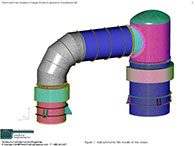 Under the ASME Code, Section VIII, Division I, Rules for Design and Fabrication of Pressure Vessels, a broad array of design formulas can be utilized in the design of robust and safe process equipment. ASME formulas, however, can be overly conservative or may not be directly applicable to unique combinations of thermal, pressure, and possibly external primary or secondary loadings. This combined with non-standard geometries and/or expensive construction materials, present design challenges that become prime candidates for finite element analysis (FEA). The use of FEA in these special cases provides an opportunity to meet ASME design requirements (under Section VIII, Division 2) while optimizing the structure for stress, ease of manufacturing, and material cost control.
FEA Thermal Stress Analysis of Large-scale Evaporator/Condenser Set
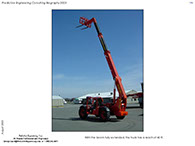 Analyzed a completely new lift truck design leveraging existing commercially viable designs from other manufacturers. The mechanical analysis included the whole lift truck structure from boom to hydraulic cylinders to engine compartment frame to the axles. The FEA model used plates, beams, rigid links, gap elements, solid elements, and springs. The boom truck was exercised through its design envelope on the computer and optimized for strength and weight.
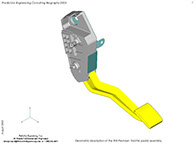 Nonlinear finite element analysis of plastic throttle pedal assembly involving extensive contact behavior between the pedal arm, body, and cover plate. These high-strength plastic parts were rigorously evaluated to optimize the design for extreme durability.
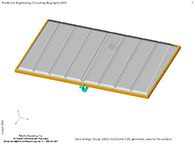 Structural analysis modeling and optimization of a low-cost, plastic solar panel for the heating of water. FEA results were used to ensure the structural integrity of the panel under high wind loads.
Structural Analysis Modeling and Optimization of a Plastic Solar Panel
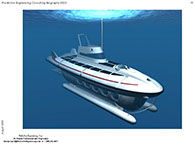 Structural analysis was performed on a deep-diving submersible vessel. A comprehensive set of finite element models was developed to fully document the stress state in the vessel. For example, hatch forgings were modeled using tetrahedral elements while the main hull structure was modeled with plate elements. For the buckling analysis, a specialized brick and plate model of the complete vessel was developed.