The Hidden Science of Data Center Cooling
How CFD Reveals Hidden Airflow Risks, Tests Critical Scenarios, and Validates Design Improvements
Software: Siemens Simcenter STAR-CCM+
The rapid expansion of artificial intelligence and high-performance computing has accelerated the construction of data centers worldwide, making reliable thermal performance a critical design challenge. Even well-designed facilities can experience airflow inefficiencies and localized thermal issues that are difficult to identify without simulation. Computational Fluid Dynamics (CFD) addresses this by evaluating design performance under a range of operating conditions.
Drawing on the expertise of Predictive Engineering's CFD engineers, this case study consolidates engineering insights from multiple data center projects to highlight common airflow challenges, cooling strategies, and best practices for improving thermal performance and system reliability.
Full CFD case study (PDF)
CFD Analysis Process
Every CFD analysis begins with the construction of a high-fidelity digital model that captures the facility's geometry in detail — server racks, raised floors, perforated tiles, CRAC/CRAH units, containment structures, and cable trays — alongside the physical operating conditions that govern the simulation, including airflow rates, equipment heat loads, fan curves, and thermal boundary conditions. These inputs are resolved using the governing equations of fluid flow and heat transfer within STAR-CCM+, which numerically solves for how air and thermal energy move and interact throughout the space under realistic operating scenarios. The resulting simulations give engineers detailed, quantitative visualizations of airflow patterns, temperature distribution, and thermal performance at any location in the facility, down to individual rack inlets and outlets. This level of insight allows engineers to pinpoint hot spots, recirculation, and bypass airflow with precision, and to test design changes and cooling strategies virtually, enabling data-driven decisions before physical implementation takes place.
Hidden Airflow Risks
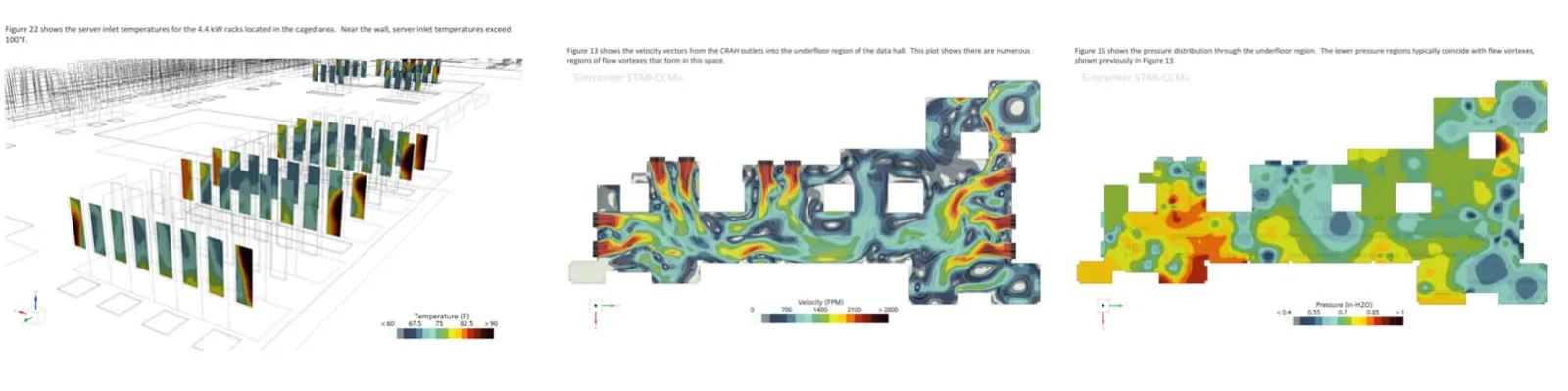
Would a new datacenter’s cooling system keep pace with its planned IT equipment load once commissioned? Predictive Engineering answered this question with a CFD analysis that uncovered hidden airflow risks — localized hot spots, air recirculation, underfloor pressure imbalances, and reverse airflow through perforated floor tiles — any of which could raise server inlet temperatures and undermine cooling effectiveness. By tracing these risks to their root causes, Predictive Engineering delivered targeted design recommendations, including airflow management modifications to reduce recirculation, improve cold-air delivery, and mitigate elevated inlet temperatures before the facility went live.
Testing Critical Scenarios
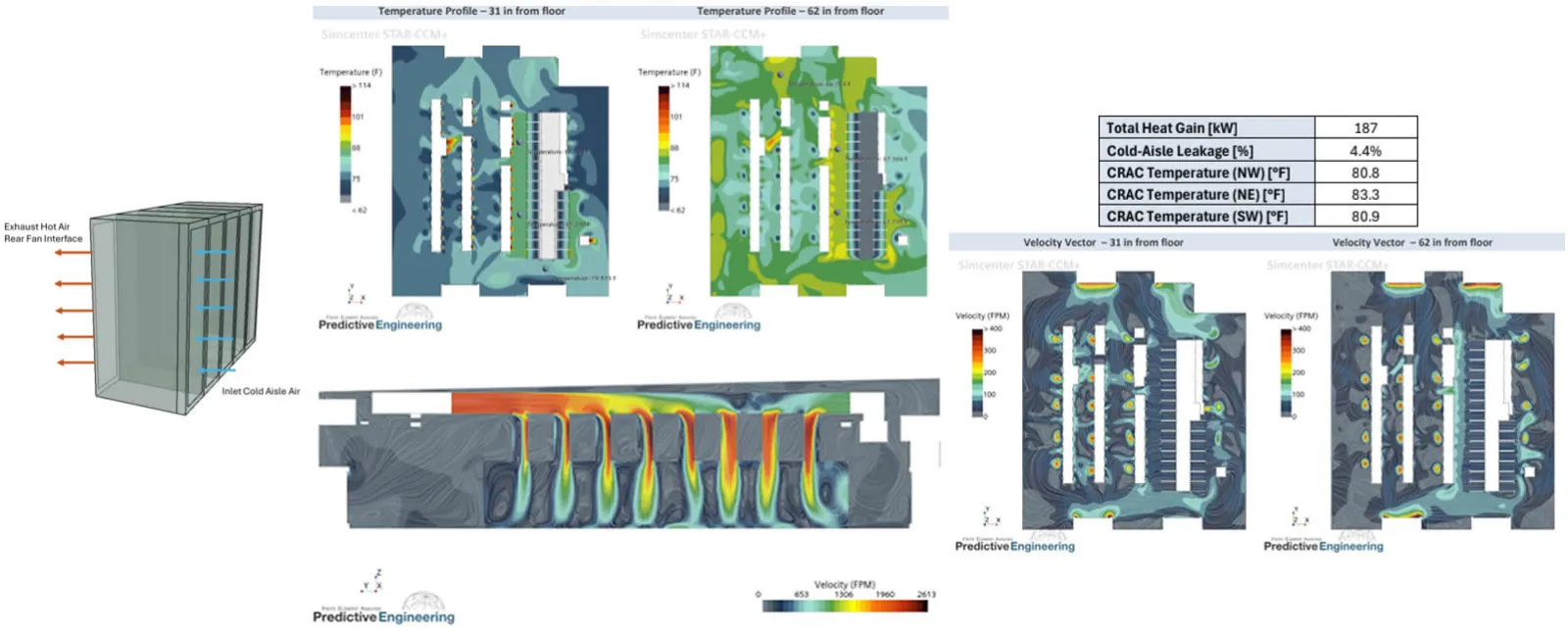
Could a datacenter’s cooling system maintain reliable thermal performance if a CRAC unit failed? Predictive Engineering tested this by simulating multiple failure scenarios — including loss of the north and south CRAC units — to evaluate airflow distribution, temperature profiles, and cooling effectiveness throughout the space. The analysis confirmed that high-power racks within the contained aisle remained adequately cooled, while also revealing localized hot exhaust plumes near lower-power racks that could affect surrounding equipment. With these findings, the client gained a clear picture of system performance under real-world failure conditions.
Validate Design Concepts and Improvements
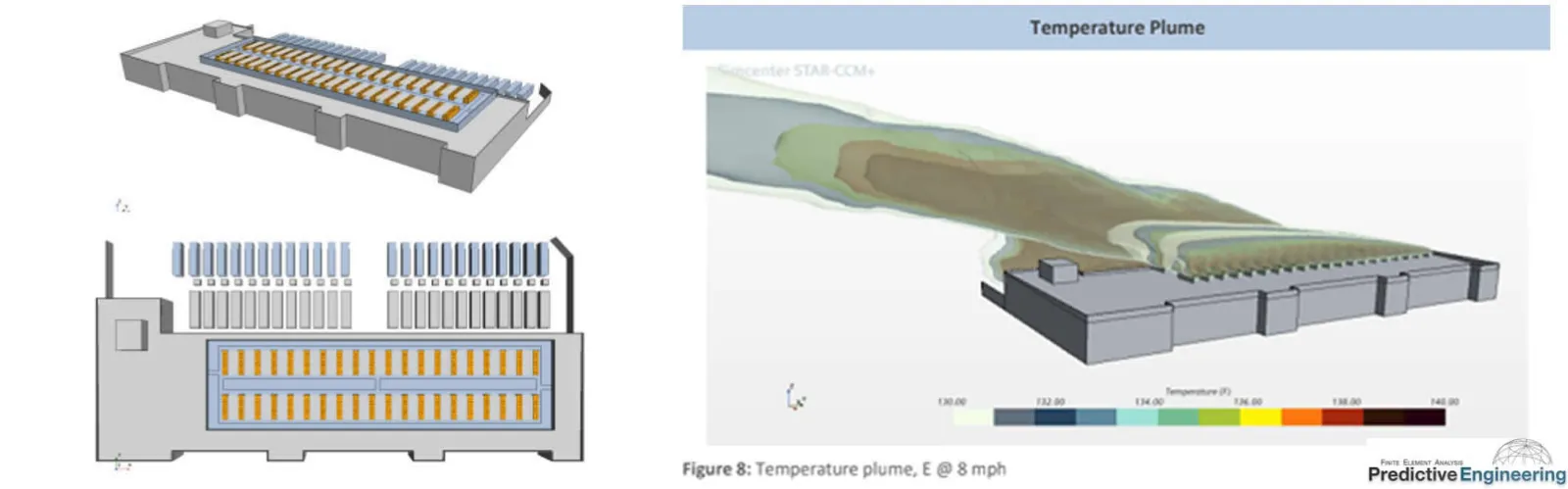
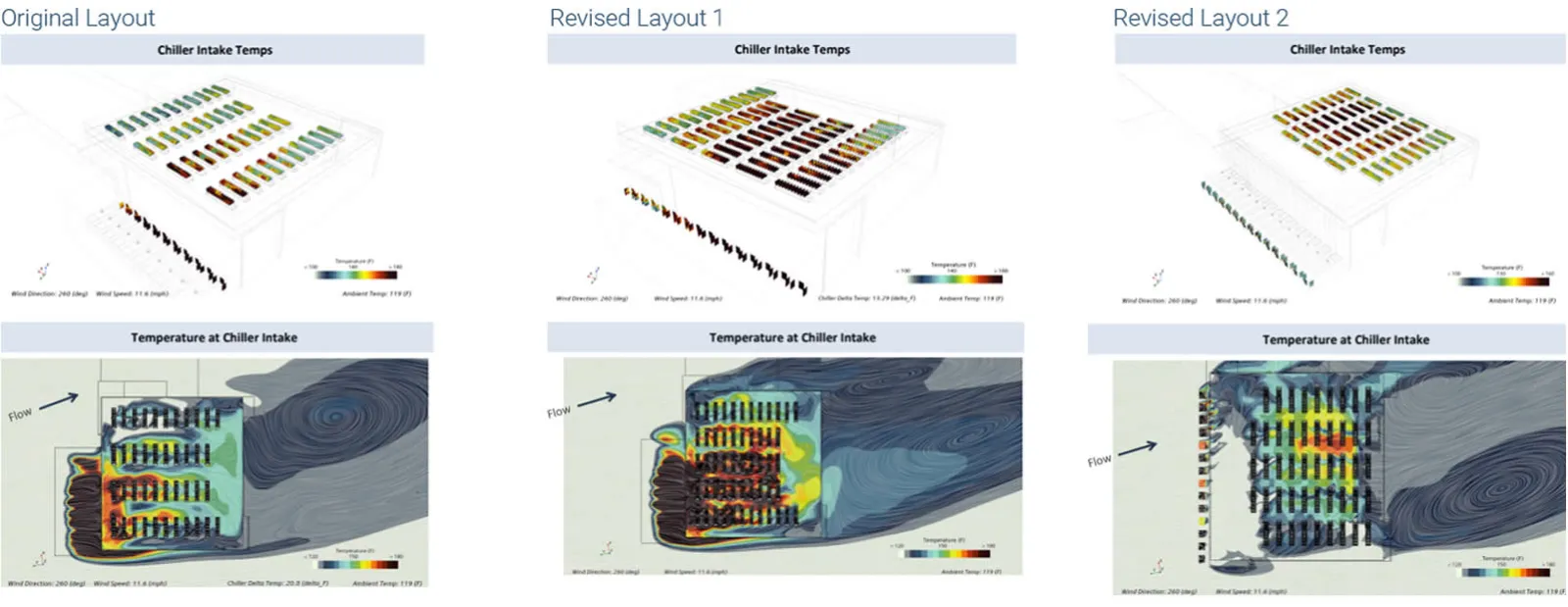
Which of several proposed data center layouts would deliver the best cooling performance under extreme ambient conditions? Predictive Engineering answered this utilizing representative wind data from a nearby airport to simulate each design concept, predicting chiller intake temperatures and airflow behavior across the board. The analysis uncovered thermal challenges specific to each layout and produced quantitative performance data the client could use to compare concepts side by side, enabling design refinements before construction began.
Let Us Solve What Others Can’t