
Wind Tunnel CFD Evaluation: Smarter Aerodynamic Testing
Why Virtual Wind Tunnel CFD Matters
Like physical testing in many industries, wind tunnel tests are costly and slow. They require multiple protypes, setting up and using specialized instrumentation, and can only offer results for limited test conditions. Depending on complexity, physical testing can also cost anywhere from $200/hr to $1000/hr.
With Computational Fluid Dynamics (CFD), engineers can use a virtual wind tunnel to predict aerodynamic performance during the design stage. This approach lets engineers identify problems earlier, reduce redesign cycles, and significantly decrease manufacturing costs. Industry case studies show that integrating CFD early in design can make development up 80% faster and reduce costs by up to 60%. In some cases a physical test may be required for design validation, but early on in the design process, when design changes are fast a frequent, a digital twin is the only cost effective way to go.
Aerospace and Automotive Applications
In aerospace, every kilogram of drag reduction translates into massive fuel savings over the lifetime of an aircraft. Virtual wind tunnel testing can help manufacturers test wing shapes, blade configurations, UAV fuselages, and even landing gear housings before physical prototypes are even built. NASA, Boeing, and other industry leaders use CFD extensively to minimize wind tunnel hours and accelerate program schedules. NASA in particular is working towards aiding advanced air mobility tests for novel aircraft designs by collecting data on critical propeller-wing interactions and publishing the results of the tests. This data will be used to enhance digital twin design tools such as CFD models to drive tiltwing designs.
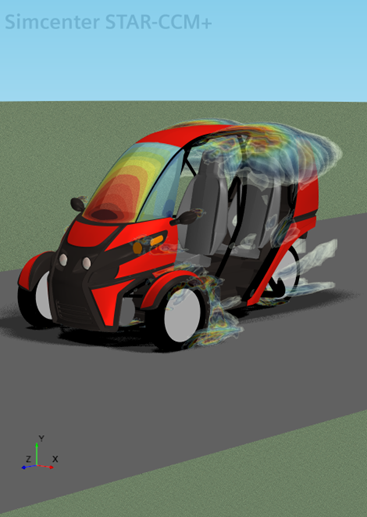
For automotive and EV manufacturers, aerodynamic efficiency directly impacts fuel consumption and battery range. CFD allows engineers to optimize body shape, radiator cooling, underbody panels, and side mirror design while testing hundreds of configurations virtually. Automakers such as Audi, report that using CFD and virtual prototyping solutions provide accurate aerodynamic predictions at constant cost and significantly reduces the need for physical wind tunnel sessions during vehicle development. Audi has stated that “virtual vehicle development solutions (such as CFD) have been instrumental in supporting new product development.” We have experience performing CFD analysis on ultra efficient utility vehicles identify ways to reduce drag and increase vehicle range
Civil and Infrastructure Applications
Can you imagine sticking downtown Chicago in a wind tunnel? (although some may argue it already lies in a wind tunnel) Civil engineering projects often face wind loading challenges. Skyscrapers, bridges, stadium roofs, and temporary traffic structures all need reliable wind performance evaluation. With CFD, engineers can simulate storm scenarios, regional wind conditions, and even extreme weather events such as hurricanes, tornadoes, and tsunamis without building scale models
For one client, we developed a realistic CFD model of the Parks RFTA Army Reserve building (a large two-story multipurpose building) to analyze winter and summer operating conditions. The building was designed using a LEED passive energy system and our analysis validated the effectiveness of this design, proving that the building could achieve net zero energy consumption.
For another client, we used CFD to ensure that the internal air flow requirements for a parking garage were met, even after some last-minute design changes. Certain decorative changes were added to the design last minute to increase the architectural appeal of the building, so the client had requested that Predictive Engineering run a CFD analysis to demonstrate the airflow through the parking garage with the added decorative designs still met local building requirements.
More general industry examples show how CFD supports architects and engineers by predicting wind loads on buildings during the earliest design phases and helping reduce uncertainty and costly design errors. CFD also enables safe design of irregular high-rise buildings by capturing complex aerodynamic effects such as vortex shedding and pressure hotspots, which would be difficult to anticipate through simplified calculations. Irregular buildings may also need advanced analysis due to localized pressure concentrations, torsional effects and cross-wind excitation, and amplified structural response due to asymmetry. Any analysis that falls short of accurately predicting how a structure will perform could spell disaster for structural safety, serviceability, and occupant comfort. For temporary traffic signals and roadside structures, CFD offers a practical way to evaluate stability under local wind climates, ensuring safety and compliance before deployment.
Consumer and Industrial Products

Smaller scale consumer products also benefit from virtual wind tunnel CFD testing by making design faster, cheaper, and more reliable. Sports and outdoor equipment benefit from virtual wind tunnel testing. CFD is used to refine golf balls, bicycle frames, helmets, bobsleds, swimsuits and surfboards for lower drag and improved performance. By performing a CFD analysis of these different product models, designers and engineers can use this analysis to identify specific areas associated with both high and low amounts of drag and stress and then make any design changes accordingly. In some cases, skinsuits for competitive biking are designed with textured patterns to create vortexes that give the rider an aerodynamic advantage and their nearby competitors an aerodynamic disadvantage, however race officials are usually quick to punish such behavior.
Drone developers use CFD to optimize propeller and body designs and extend flight time and range. Beyond drones and sports gear, CFD supports prototyping for small consumer aircraft and 3D-printed gadgets, allowing teams to test virtually before building physical models. This speeds up iteration cycles and reduces development costs dramatically. CFD is also used to validate designs of different industrial equipment. We have experience validating that machinery, such as scissor lifts, can safely operate under different levels of wind loads.
What We Deliver in a Wind Tunnel CFD Evaluation
A CFD evaluation provides decision-makers with clear results and engineers with credible data. In our deliverables we translate complex simulation results into clear, visually rich, and actionable reports that typically include quantified drag and lift predictions, flow visualization with streamlines and velocity fields, surface pressure mapping for design improvements, and identification of flow separation or turbulence zones. These insights guide product refinement and give management a clear view of performance tradeoffs and ROI.
Why Work with Us
Our simulation experts at Predictive Engineering bring decades of experience in CFD analysis with industry-leading solvers such as Simcenter STAR-CCM+. We translate complex data into clear reports that include executive summaries, high-resolution graphics, and actionable recommendations. This balanced approach gives executives the clarity they need and engineers the technical foundation to refine the product efficiently and effectively.