Predictive Engineering featured on Engineering.com

Engineering.com featured Predictive Engineering in its article ASME Simulation Analysis for Pressure Vessels, in which Adrian Jensen and George Laird walk through the analysis and optimization of an ASME Section VIII pressure vessel. As the article states, "without the proper safety measures engineering pressure vessels can go bad quickly and with deadly consequences."
When does a pressure vessel need Division 2?
For Adrian Jensen, Sr. Staff Mechanical Engineer at Predictive Engineering, the dividing line is geometry and loading. A tank with standard geometry under simple pressure can be checked with the Division 1 hand calculations. Once the geometry is non-standard (complex shapes, steep nozzle angles, sharp transitions) or the vessel sees thermal, seismic or cyclic loads, it falls under Division 2 and its design-by-analysis rules, and finite element analysis becomes the practical way to qualify it. Seismic certification can call for FEA even when the geometry itself is standard.
What the work involved
- Nozzle welds: the shell and nozzle were modeled with plate elements, and the stresses were evaluated at the weld toe as ASME requires, not at the mid-plane intersection, where a plate model shows artificially high values.
- Membrane stresses: ASME needs the mid-plane membrane stress in addition to the top and bottom plate stresses. These were computed through the Femap API, together with Femap's ASME stress intensity and stress linearization tools.
- Cryogenic fill: a vessel at room temperature is filled with liquid oxygen at about -355 °F, which causes large contraction and tensile stresses. The transient thermal model switched its boundary conditions as the liquid level rose, since boiling at the wetted wall gives a very high heat transfer coefficient. The 15-minute fill was split into 90 time steps, and all 90 thermal stress cases were solved in about five minutes by reusing a single Nastran stiffness matrix.
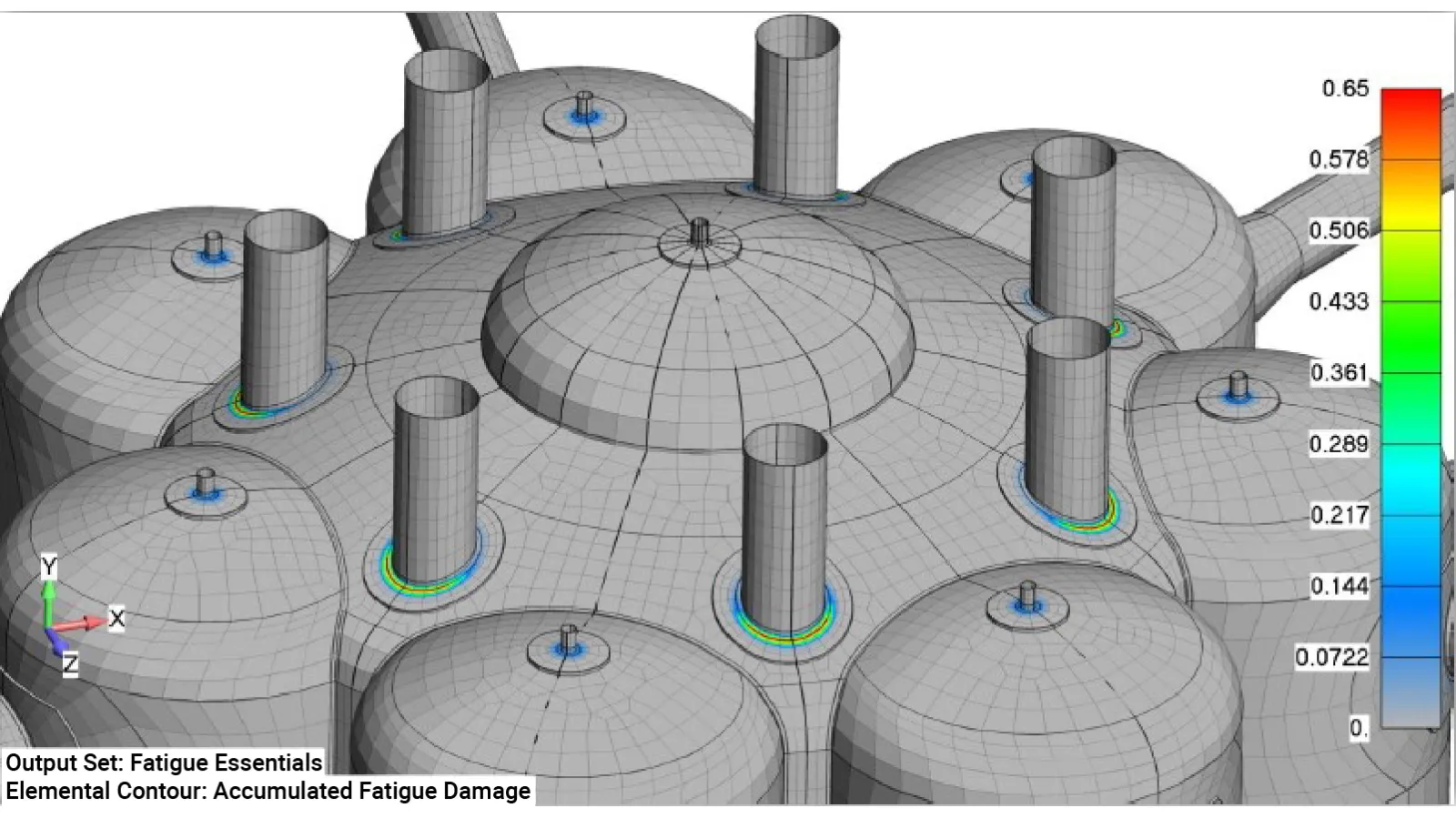
- Fatigue: once the vessel passes its primary load checks, it is evaluated for cyclic thermal and mechanical fatigue. Building the load combinations and finding the worst stress range by hand took about 90 minutes per hot spot, which led the team to develop Fatigue Essentials to automate the process.
George Laird's advice from the article: understand the physics and check the first-order answer by hand before trusting the software.
Related work
- ASME Section VIII, Division 2 "Design-by-Analysis" Pressure Vessel Consulting
- ASME Section VIII, Div 2 High-Pressure LOX Tank Analysis
- ASME Section VIII Pressure Vessel: Nozzle Load Application with Software Automation
- ASME Section VIII, Division 2 Fatigue Analysis of Pressure Vessels
- ASME BPVC Fatigue Analysis – Part 5.5: Protection Against Failure from Cyclic Loading
- Explore Fatigue Essentials and Ditch Your Fatigue Analysis Spreadsheets
Fatigue Essentials Analysis of a Pressure Vessel
Accumulated fatigue damage over the pressure vessel, evaluated with Fatigue Essentials.
Predictive Engineering – The Advantage of Getting it Right the First Time